
Dr Graham Treece, Department of Engineering
Part of the portal venous system, reconstructed from six ultrasound B-scans.
A child's skull, reconstructed from a varying number of Computed Tomography images.
Videos
Here are some very old videos of surface reconstructions and morphing sequences ...In vivo surface reconstruction
The following are some surfaces which have been reconstructed from cross-sections of ultrasound data, by a variety of techniques (see the publications page for more information on the techniques). In each case, the last video is my technique. The surfaces are triangulated using Regularised Marching Tetrahedra. Click on any of the images to see a video of the surface rotating. Note that all these images and videos have been generated at very low resolutions in order to make them possible to download! The real thing is of much higher quality. A 25 week foetus, reconstructed from 30 ultrasound B-scans. 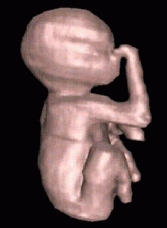 Reconstruction using Shape Based Interpolation. \ |
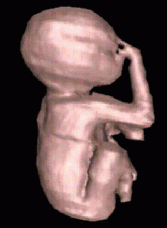 Reconstruction using Shape Based Interpolation, using centroids to guide the interpolation direction \ |
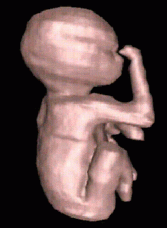 Reconstruction using an improved version of Disc Guided Interpolation, presented in another technical report. \ |
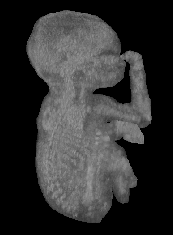 You can also volume render the actual ultrasound data which the previous surfaces were based on. \ |
| \ |
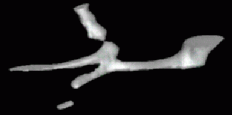 Reconstruction using Shape Based Interpolation. \ |
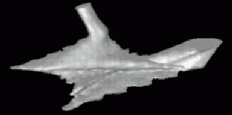 Reconstruction using Shape Based Interpolation, using centroids to guide the interpolation direction.\ |
\ |
| \ |
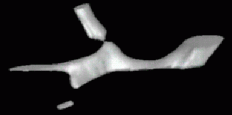 Reconstruction using Maximal Disc Guided Interpolation, as presented in a technical report. \ |
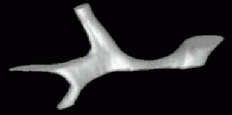 Reconstruction using an improved version of Disc Guided Interpolation, presented in another technical report \ |
\ |
| \ |
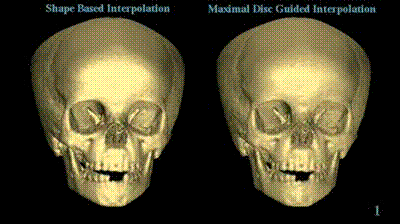 My technique (on the right) compared to Shape Based Interpolation (on the left). Each time the skulls rotate, the number of cross-sections used to define the surface is reduced, starting at 145 and finishing at 20. The skull on the left clearly degrades more quickly than that on the right. \ |
\ |
| \ |
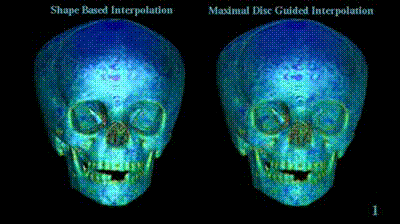 The same as above, save that the surface has been colour coded with an estimate of surface curvature (deep blue for low curvature, to red for high curvature). This accentuates the areas of poor surface interpolation. \ |
\ |
Morphing Sequences
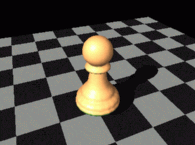
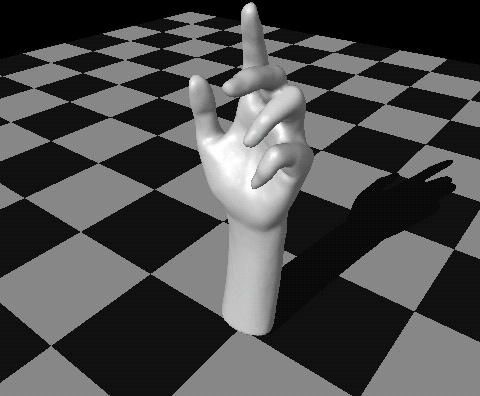
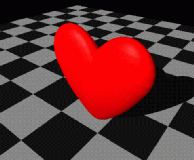
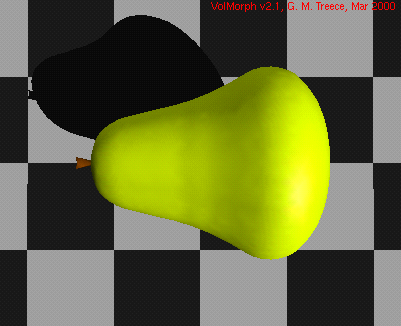
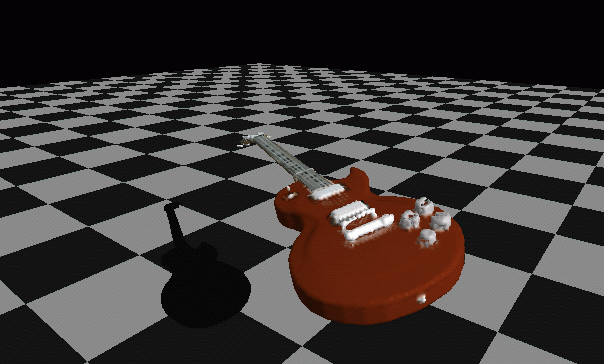
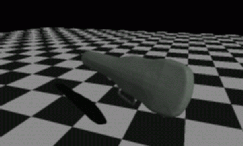
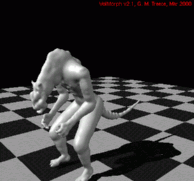
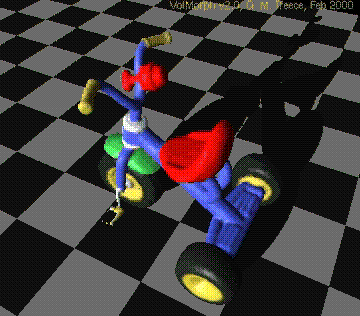
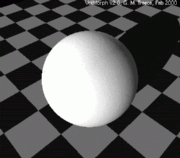
You can also apply essentially the same algorithm used to interpolate the cross-sections above to form surfaces to the interpolation of surfaces themselves. This can be used to generate a sequence of interpolated surfaces in between an initial and a final surface - i.e. a three-dimensional morph. Unlike conventional 2D image morphing, 3D morphing enables you to change the camera viewpoint and lighting parameters during the morphing sequence. Here are a couple of examples, both generated using software which is available to download, and described in a technical report. Note that all these images and videos have been generated at very low resolutions in order to make them possible to download! The real thing is of much higher quality.| \ |
Source model (click on image for larger version). \ |
Target model (click on image for mpeg video). \ |
\ |
| \ |
 \ |
 \ |
\ |
| \ |
 \ |
 \ |
\ |
| \ |
 \ |
 \ |
\ |
| \ |
 \ |
 \ |
\ |
| \ |
 \ |
 \ |
\ |
| \ |
 \ |
 \ |
\ |
- Graham Treece
- Introduction
- Teaching
- Research
- Publications
- Software
- Videos
- Personal
- Medical Imaging Group
- Overview
- Members
- Projects
- Research Opportunities
- Free Software
- Machine Intelligence Homepage